
- Many countries offer a temporary or PR visa in exchange for an investment
- Investment amounts can range from $50,000 to $500,000 or more




In demand occupations in Canada, In demand careers in Canada, High demand jobs in Canada, Canada work visa, Canada work visa types, apply for jobs in Canada, requirements for work permit in Canada, Canada work visa permit, Canada work permit, Canada work visa
Explore the top in demand jobs in Canada for 2025 with average salaries. Find career opportunities in healthcare, tech, finance, and more across provinces.
Top In Demand Occupations in Canada
Canada's job market is looking good, with more than 700,000 job openings across the country as of early 2025. Sectors like healthcare, tech, skilled trades, and education are really short on workers, which makes them top priorities for immigration and hiring. For instance, healthcare has over 120,000 job vacancies and tech roles are increasing by 25% each year.
The table below has the list of In-demand occupations in Canada:
| Occupations | Job Opportunities in Canada | Average Salaries per Year |
|---|---|---|
| Engineering | 150,000 | $125,541 |
| IT | 132,000 | $101,688 |
| Marketing & Sales | 85,200 | $92,829 |
| HR | 64,300 | $65,386 |
| Healthcare | 248,000 | $126,495 |
| Teachers | 73,200 | $48,750 |
| Accountants | 163,000 | $65,386 |
| Hospitality | 93,600 | $58,221 |
| Nursing | 67,495 | $71,894 |
Why work in Canada?
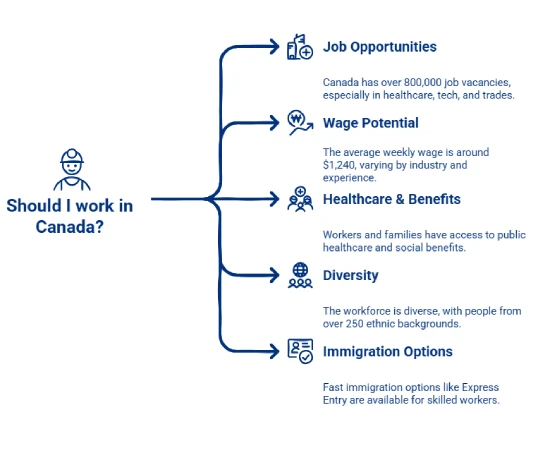
Canada has a lively job market, good living standards, and solid support systems, making it a great place for professionals from around the world. With over 800,000 job openings right now, there are plenty of chances for career growth and moving to the country.
- There are more than 800,000 job vacancies across Canada as of early 2025, especially in healthcare, tech, and trades.
- The average weekly wage for full-time jobs is around $1,240, depending on the industry and experience.
- Workers and their families have access to public healthcare and social benefits.
- The workforce is diverse, with people from over 250 different ethnic backgrounds.
- There are fast immigration options like Express Entry and Provincial Nominee Programs for skilled workers.
Canada Work Permit
A Canada Work Permit lets foreign workers legally work in Canada for a specific employer, job, and time period. You usually need a valid job offer from a Canadian company to get one, and in many cases, you might also need a Labour Market Impact Assessment (LMIA). There are two main kinds of work permits: Employer Specific Work Permits and Open Work Permits, which depend on your circumstances. Having a work permit can also help you move toward permanent residency through programs like Express Entry or Provincial Nominee Programs.
*Want to apply for a Canada work visa? Get in touch with experts at Y-Axis to assist you with the procedure.
Types of Canada work visa
Canada has different types of work permits to bring in skilled workers for its growing economy. There are two main kinds: Open Work Permits, which let you work for any employer, and Employer Specific Work Permits, which tie you to one company and job.
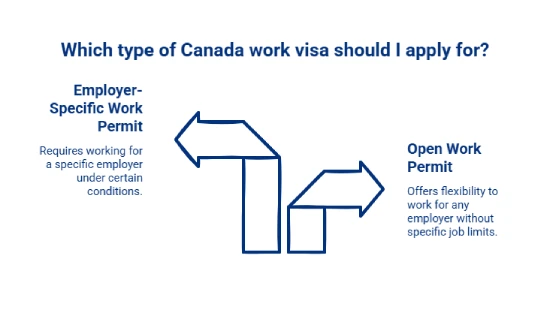
The table below gives you a complete overview of the Canada work visa types:
| Work Permit Type | Description | Types of Work Visas |
|---|---|---|
| Open Work Permit | You can work for any employer in Canada without specific job limits. | Post-Graduation Work Permit (PGWP) |
| Spousal Open Work Permit | ||
| Bridging Open Work Permit (BOWP) | ||
| International Experience Canada (IEC) | ||
| Employer-Specific Work Permit | You can only work for the employer listed on the permit under certain conditions. | Temporary Foreign Worker Program (TFWP) |
| LMIA-based Work Permit | ||
| Intra-Company Transfer | ||
| Global Talent Stream |
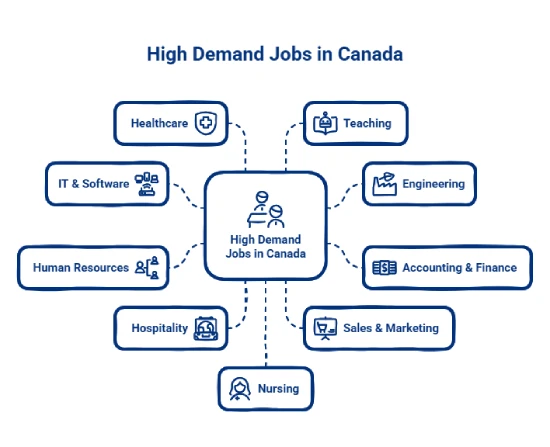
List of High Demand Jobs in Canada
Canada has a lot of well-paid job opportunities in different fields. Whether you're already in your career or just graduating, there are good jobs out there to help you thrive.
Given below is an overview of the highest-paying jobs in Canada, along with salary info and growth trends.
1. IT & Software Jobs in Canada
Canada’s booming tech sector offers a wide array of roles for software developers, engineers, and IT professionals.
Average Salary: CAD 83,031/year
Salary Range: CAD 64,158 to CAD 130,064/year
2. Engineering Jobs in Canada
Engineering managers and technical experts are in demand, especially in infrastructure, renewable energy, and manufacturing.
Average Salary: CAD 77,423/year
Salary Range: CAD 54,443 to CAD 138,778/year
3. Accounting & Finance Jobs in Canada
Accounting and finance professionals are highly valued across industries, with strong earning potential.
Average Salary: CAD 105,000/year
Salary Range: CAD 65,756 to CAD 193,149/year
4. Human Resources Jobs in Canada
With every growing company comes a need for HR professionals to support the workforce and compliance.
Average Salary: CAD 95,382/year
Salary Range: CAD 78,495 to CAD 171,337/year
5. Hospitality Jobs in Canada
Canada’s tourism and hospitality industries are recovering strongly, creating new employment opportunities.
Average Salary: CAD 55,000/year
Salary Range: CAD 37,811 to CAD 96,041/year
6. Sales & Marketing Jobs in Canada
Dynamic and performance-driven, sales and marketing roles offer career growth and financial rewards.
Average Salary: CAD 77,350/year
Salary Range: CAD 48,853 to CAD 165,500/year
7. Healthcare Jobs in Canada
Canada’s healthcare sector is actively hiring doctors, nurses, technicians, and allied professionals.
Average Salary: CAD 91,349/year
Salary Range: CAD 48,022 to CAD 151,657/year
8. Teaching Jobs in Canada
Teachers are in demand across Canada’s provinces and territories, especially in remote and rural areas.
Average Salary: CAD 63,989/year
Salary Range: CAD 45,000 to CAD 107,094/year
9. Nursing Jobs in Canada
With over 17,000 openings, nursing continues to be one of the most in-demand healthcare occupations.
Average Salary: CAD 58,500/year
Salary Range: CAD 42,667 to CAD 105,109/year
Province Wise in Demand Jobs in Canada
Canada's job market is pretty varied, with each province having its own specific needs, especially in sectors that are growing fast.
Here's a look at the most in demand jobs by province:
| Province/Territory | Top In-Demand Job Categories |
|---|---|
| Ontario | Software Developers & Programmers; Registered Nurses; Administrative Assistants; Sales Associates |
| British Columbia | Healthcare (Nurses, Personal Support); Tech Support & IT; Hospitality Supervisors |
| Alberta | Skilled Trades (Electricians, Mechanics); Administrative Assistants; Business & Finance Roles |
| Manitoba | Customer Service; Administrative Assistants; Social Services Coordinators |
| New Brunswick | Healthcare Aides; School Education Assistants; Construction Trades |
| Nova Scotia | Hospitality Staff (Cooks, Servers); Healthcare Positions; Sales Representatives |
| Québec | Retail Sales; Food Service Supervisors; IT Specialists |
| Saskatchewan | Skilled Trades; Healthcare Support; IT Occupations |
| Newfoundland & Labrador | Healthcare Professionals; Administrative Assistants; Tech Roles |
| Northwest Territories | Health Care Aides; Administrative Roles; Skilled Trades |
| Yukon | Hospitality & Tourism; Tech Support; Healthcare Clinics |
| Nunavut | Skilled Trades; Healthcare Aides; Community Support Workers |
Eligibility Criteria for Canada work visa
Individuals looking to work in Canada must fulfill certain eligibility requirements.
Given below is the list of general criteria to be fulfilled while applying for a work visa in Canada:
- A job offer from a Canadian employer (if needed)
- Labour Market Impact Assessment (LMIA), if necessary
- A valid passport or travel document
- Proof that you plan to leave Canada when your work permit ends
- Enough money to support yourself and any family members with you
- No criminal record (you might need a police clearance)
- A medical examination, if needed
- No threat to Canadian safety
- Not planning to work for an employer that isn’t approved
- Following the visa rules
- Language skills, if the job requires them
Canada Work Visa for On Shore Candidates
If you are applying from inside Canada, here’s what you need to know:
- You must have a valid study or work permit.
- If you’re applying with dependents like a spouse, common-law partner, or parent, they also need a valid study or work permit.
- For the Post Graduation Work Permit (PGWP), make sure your study permit is valid when you apply.
- Temporary foreign workers should have a work permit with at least six months left.
- If you’re waiting for Canada PR approval, you can work with a bridging open work permit.
- You need to be recognized as a protected person or refugee claimant to work in Canada.
- Some individuals can work without a permit, but they must apply if they want to change jobs.
Eligibility Criteria to Apply from Outside Canada
If you are applying from outside Canada, here’s what you should consider:
- You need to meet Canada's requirements based on your home country and what type of work permit you're applying for.
- A valid job offer from a Canadian employer is usually necessary, and it might need a Labour Market Impact Assessment (LMIA).
- You will need to provide proof of your qualifications, like your education and work experience.
- You must meet health and criminal background checks.
- You should show that you plan to return home once your permit expires unless you’re applying for PR pathways.
Eligibility Criteria after Arrival in Canada
For those wanting to apply after arriving in Canada:
- You need to apply for a work permit before entering the country unless you qualify to apply at the port of entry.
- You can apply after arriving if you have a valid electronic travel authorization (eTA), are eligible under certain agreements (like CUSMA or IEC), or meet other requirements for the specific work permit you’re aiming for.
Requirements to Work in Canada
You must meet the below requirements to work in Canada:
- You must plan to leave Canada when your work permit runs out.
- Show you have enough money to support yourself and your family, plus cover travel costs back home.
- Make sure you have a clean criminal record and can provide police certificates if asked.
- Stay in good health, and be ready to do a medical exam if necessary.
- You shouldn't pose any security risks to Canada.
- Don't work for employers that aren't allowed (like those on a non-compliance list or escort services).
- Be prepared to provide all the required documents, such as your ID, job offer, and LMIA if needed.
Immigration Pathways to Move to Canada for Work
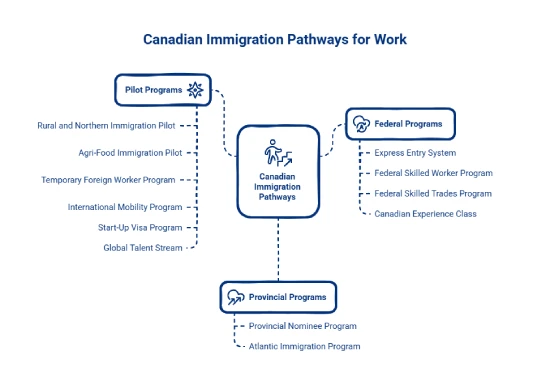
Canada has different immigration programs at both the federal and provincial levels aimed at bringing in skilled workers, entrepreneurs, and professionals who want to work and are looking for long-term settlement.
Given below is the list of top Canadian immigration pathways:
- Express Entry System
- Federal Skilled Worker Program (FSWP)
- Federal Skilled Trades Program (FSTP)
- Canadian Experience Class (CEC)
- Provincial Nominee Program (PNP)
- Atlantic Immigration Program (AIP)
- Rural and Northern Immigration Pilot (RNIP)
- Agri-Food Immigration Pilot
- Temporary Foreign Worker Program (TFWP)
- International Mobility Program (IMP)
- Start-Up Visa Program
- Global Talent Stream (under TFWP)
*Want to migrate to Canada? Get in touch with experts at Y-Axis to assist you with the process.
How to Apply for Jobs in Canada from Abroad?
You can follow the below steps to apply for jobs in Canada from abroad:
Step 1: Research the job market in Canada.
Step 2: Create a resume and cover letter that match Canadian standards.
Step 3: Apply for jobs on reliable Canadian job websites.
Step 4: Get your credentials checked if needed.
Step 5: Take a language test like IELTS, CELPIP, or TEF.
Step 6: Make sure you have a valid job offer.
Step 7: Apply for a work permit or PR visa for Canada.
Step 8: Collect and organize all necessary documents.
Step 9: Submit your application on the IRCC website.
How can Y-Axis help you?
Y-Axis is the world's No.1 overseas Immigration consultant, providing unbiased and innovative immigration assistance for 25+ years.
Our team of experts will assist you with:
- Check free eligibility through the Y-Axis Canada Immigration Points Calculator
- Filling out the application form
- Assistance to migrate to Canada
- Assistance to apply for a Canada work visa.
- Arranging the requirements
- Looking for jobs in Canada? Avail Y-Axis Resume Marketing Services to find the right one!
- Guidance to obtain Canada PR