Explore top Canada immigration programs. Learn about Express Entry, PNP, eligibility, PR process & visa fees for skilled workers and families.
Canada Immigration, Migrate to Canada, Canada immigration, Canada PR process, Express Entry Canada, Immigrate to Canada, Canada PR requirements, Canada visa application, Canada immigration for skilled workers, Canada permanent resident visa, Canada PR eligibility, Canada immigration programs

I accept Terms & Condition






Canada Immigration on a PR Visa
Canada stands out as an immigrant-welcoming nation which intends to accept 1.45 million new residents between now and 2026. Canada provides Permanent Residence (PR) programs that target skilled professionals along with students and entrepreneurs through various pathways. The professional opportunities of Canada combined with its high-quality public services and diverse population create an attractive environment for those seeking a new beginning.
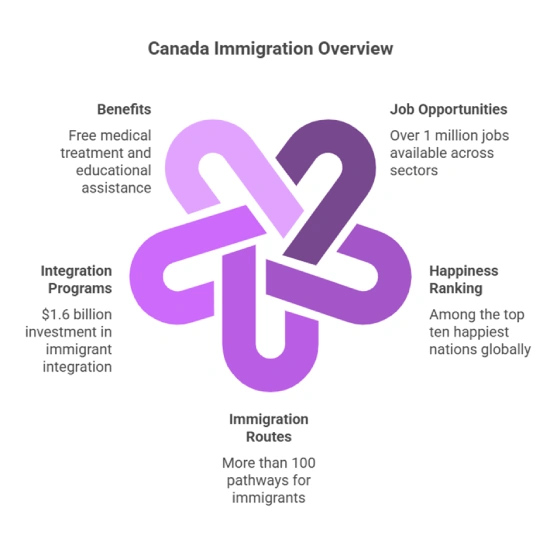
- Canada has more than 1 million job opportunities available across different employment sectors.
- It holds a position in the top ten happiest nations globally.
- The country provides more than 100 routes to immigrants who want to move to Canada.
- Immigrant integration programs have received more than $1.6 billion for development.
- Get free medical treatment along with financial assistance for educational costs.
Canada Immigration Pathways
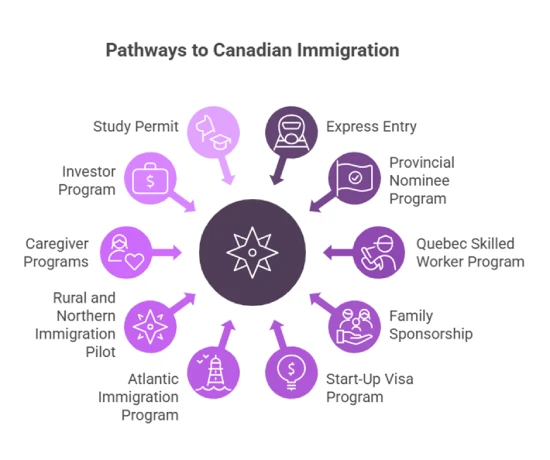
Canada offers a variety of immigration programs designed for skilled workers, families, students, and entrepreneurs. Each pathway has its own eligibility rules and benefits, giving applicants multiple options to achieve permanent residency. Below is a quick overview of the most popular programs.
Canada Express Entry (EE)
A points-based system that manages applications under the Federal Skilled Worker (FSW), Canadian Experience Class (CEC), and Federal Skilled Trades (FST). It is one of the fastest and most popular ways to immigrate.
Canada Provincial Nominee Programs (PNPs)
Run by individual provinces to meet local labour market needs. Candidates may be nominated based on work experience, job offers, or ties to the province.
Atlantic Immigration Program (AIP)
An employer-driven program for applicants with job offers in Atlantic Canada (Nova Scotia, New Brunswick, Prince Edward Island, and Newfoundland & Labrador).
Family Sponsorship
Allows Canadian citizens and permanent residents to sponsor close relatives such as spouses, partners, dependent children, and—under limited intake—parents and grandparents.
Quebec Immigration Programs
Quebec manages its own programs, including the Arrima system and PEQ (Quebec Experience Program), with distinct selection criteria, often emphasizing French language ability.
Study → Work → PR Pathway
International students can study in Canada, obtain a Post-Graduation Work Permit (PGWP), and gain Canadian work experience, and later transition to permanent residency.
Business, Investor, and Entrepreneur Programs
Options for investors, entrepreneurs, and senior managers who wish to establish or invest in Canadian businesses while pursuing permanent residency.
Detailed Breakdown of Canada Immigration Programs
Canada offers several immigration programs, each tailored to different applicant profiles. Below is a closer look at the main pathways, their benefits, and expected timelines.
Canada Immigration – Express Entry
Canada allows skilled professionals to obtain permanent residency through its Express Entry pathway which serves as the nation's top immigration program. The system functions through its online platform to handle applications for the three main federal immigration programs:
- Federal Skilled Worker Program (FSWP)
- Federal Skilled Trades Program (FSTP)
- Canadian Experience Class (CEC)
The Comprehensive Ranking System (CRS) evaluates applicants through multiple factors including age, education, language skills, and work experience. Regular draws select the top ranking candidates in the pool to issue Invitations to Apply (ITAs) for permanent residence.
The FSWP requires applicants to achieve a minimum score of 67 points on the initial eligibility grid to qualify. The speed and transparency of the Express Entry system have enabled many candidates to obtain permanent residence in less than 6 months after receiving an invitation. The Express Entry system provides foreigners and domestic applicants with a direct and effective route towards permanent residency status.
*Want to apply for Express Entry? Let Y-Axis guide you with the steps.
Express Entry Draw Updates
| Draw No. | Date | Immigration Program | Invitations Issued |
|---|---|---|---|
| 408 | April 2, 2026 | Trades Occupations, 2026-Version 3 | 3,000 |
| 407 | March 31, 2026 | Canadian Experience Class | 2,250 |
| 406 | March 30, 2026 | Provincial Nominee Program | 356 |
| 405 | March 18, 2026 | French-Language proficiency 2026-Version 2 | 4,000 |
| 404 | March 17, 2026 | Canadian Experience Class | 4,000 |
| 403 | March 16, 2026 | Provincial Nominee Program | 362 |
| 402 | March 05, 2026 | Senior managers with Canadian Work Experience | 250 |
| 401 | March 04, 2026 | French language proficiency | 5,500 |
| 400 | March 03, 2026 | Canadian Experience Class | 4,000 |
| 399 | March 02, 2026 | Provincial Nominee Program | 264 |
| 398 | February 20, 2026 | Healthcare and Social Services Occupations | 4,000 |
| 397 | February 19, 2026 | Physicians with Canadian Work Experience, 2026-Version 1 | 391 |
| 396 | February 17, 2026 | Canadian Experience Class | 6,000 |
| 395 | February 16, 2026 | Provincial Nominee Program | 279 |
| 394 | February 06, 2026 | French Language Proficiency | 8,500 |
| 393 | February 03, 2026 | Provincial Nominee Program | 423 |
| 392 | January 21, 2026 | Canadian Experience Class | 6,000 |
| 391 | January 20, 2026 | Provincial Nominee Program | 681 |
| 390 | January 07, 2026 | Canadian Experience Class | 8,000 |
| 389 | January 05, 2026 | Provincial Nominee Program | 574 |
Immigration to Canada – PNP
The Provincial Nominee Program (PNP) is for Canadian territories and provinces, allowing them to select immigrants with appropriate abilities as well as educational background and professional experience to support their regional development. The program is an excellent choice for candidates with lower CRS scores who desire to establish themselves in particular Canadian provinces. The PNP system features numerous streams which work together with Express Entry to deliver quicker application processing.
Some of the popular PNP Programs in Canada are as follows:
- Ontario Immigrant Nominee Program (OINP)
- British Columbia Provincial Nominee Program (BC PNP)
- Alberta Advantage Immigration Program (AAIP)
- Saskatchewan Immigrant Nominee Program (SINP)
- Manitoba Provincial Nominee Program (MPNP)
- Nova Scotia Nominee Program (NSNP)
- New Brunswick Provincial Nominee Program (NBPNP)
- Prince Edward Island Provincial Nominee Program (PEI PNP)
- Newfoundland and Labrador PNP (NLPNP)
- Northwest Territories Nominee Program (NTNP)
- Yukon Nominee Program (YNP)
*Looking to apply for Canada PNP? Let experts at Y-Axis guide you with the process.
How to Migrate to Canada - QSWP
The Quebec Skilled Worker Program (QSWP) provides skilled professionals with a gateway to achieve permanent residence while working in Quebec. Quebec operates its own selection procedures exclusively and does not participate in the Express Entry system. Quebec uses a point-based evaluation system to examine candidates based on their educational history, work history, age as well as their French language knowledge. Successful candidates receive a CSQ (Quebec Selection Certificate) which enables them to submit an application to IRCC for permanent resident status.
- Independent of the Express Entry system
- Requires a minimum of 50–59 points based on profile
- Prioritizes French language skills
- Offers a CSQ (Quebec Selection Certificate)
- Ideal for settling in Quebec cities like Montreal and Quebec City
*Check your eligibility to Quebec through the Y-Axis Quebec Immigration Points Calculator.
Family Sponsorship
Best for: Canadian citizens and permanent residents sponsoring their spouse, partner, dependent children, or—under limited intake—parents and grandparents.
Highlights: Sponsors commit to financial support during a fixed undertaking period. Applications undergo genuineness and admissibility checks.
Typical Timeline: Spousal and partner sponsorships often take around 12 months; parent and grandparent sponsorships generally take longer.
Latest Canada Draws (Express Entry & PNP) in 2026
The table below consists of the latest draws held in 2026:
| 72,761 Invitations Issued in 2026 | |||||
|---|---|---|---|---|---|
| Express Entry / Province | Jan | Feb | Mar | Apr | Total |
| Express Entry | 15,225 | 19,593 | 20,982 | 3,000 | 58,800 |
| Manitoba | 102 | 101 | 60 | NA | 263 |
| British Columbia | 7 | 907 | 12 | NA | 926 |
| Ontario | NA | 3,229 | 2,355 | 759 | 6,343 |
| Alberta | 254 | 2,305 | 1,417 | NA | 3,976 |
| Prince Edward Island | 26 | 109 | 101 | NA | 236 |
| Newfoundland and Labrador | NA | NA | 690 | NA | 690 |
| New Brunswick | 379 | 526 | 622 | NA | 1,527 |
| Total | 15,993 | 26,770 | 26,239 | 3,759 | 72,761 |
Canada Immigration Eligibility
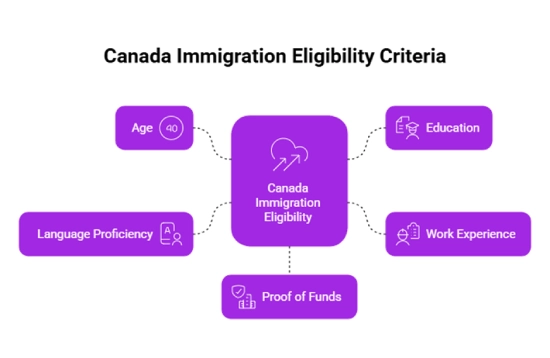
To be eligible, you typically need:
- Age below 45 years (max points for 20–35)
- Bachelor's degree or higher
- 1+ year full-time skilled work experience
- IELTS score of CLB 7 or higher
- Proof of funds (approx. CAD 13,757 for single applicant)
*Check your eligibility for Canada through the Y-Axis Canada CRS Score Calculator.
Eligibility Checklists for Canada Immigration Pathways
Before applying for any immigration pathway, it’s important to ensure you meet the minimum eligibility requirements. Below is a quick checklist for the major Canadian immigration programs.
| Program | Eligibility Requirements |
|---|---|
| Express Entry (FSW / CEC / FST) | Meet age and education requirements ECA for non-Canadian education Valid language test (IELTS, CELPIP, TEF, or TCF) Skilled work experience aligned with NOC 2021 (TEER) Proof of funds (if required) Admissibility and accurate work references |
| Provincial Nominee Programs (PNPs) | Fulfil stream-specific rules (occupation, points, or job offer) Meet language and education requirements of the province Demonstrate intent to reside in the nominating province Employer forms (if employer-driven) Proof of ties, study, or work history in the province |
| Atlantic Immigration Program (AIP) | Valid job offer from a designated employer in Atlantic Canada Meet education and language thresholds for the role Settlement plan and employer endorsement Proof of funds (if required) |
| Family Sponsorship | Sponsor must be 18+ and a Canadian citizen or permanent resident PR sponsors must live in Canada; citizens abroad must show intent to return Signed undertaking and income requirements for PGP Proof of genuine relationship Admissibility of the applicant |
| Quebec Immigration Programs (Regular / PEQ / Business) | Intention to permanently live in Quebec Meet points grid or program criteria Arrima profile where required French language ability may be essential Financial self-sufficiency declaration and admissibility |
Canadian Immigration Requirements
The basic documents required for a PR application:
- Valid passport
- Educational Credential Assessment (ECA)
- IELTS/CELPIP language test results
- Proof of work experience
- Medical exam & police clearance
- Proof of funds and relationship documents (if applicable)
Canada Immigration Points
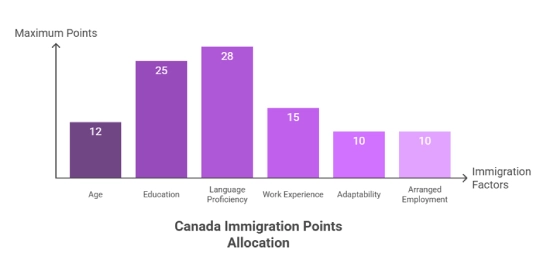
Canada evaluates permanent residency applicants through its points-based system, which mainly operates within the Express Entry program. The immigration pool sorts candidates based on their points from age, education, work experience, language skills and additional criteria.
| Factors | Points |
|---|---|
| Age | Maximum 12 points |
| Education | Maximum 25 points |
| Language Proficiency | Maximum 28 points (English and French) |
| Work Experience | Maximum 15 points |
| Adaptability | Maximum 10 points |
| Arranged Employment | Additional 10 points (not mandatory) |
Canada Immigration Process
Step 1: Take the IELTS or CELPIP test to prove language proficiency.
Step 2: Get your educational credentials assessed through ECA (e.g. WES).
Step 3: Create and submit your Express Entry profile online.
Step 4: Receive an Invitation to Apply (ITA) if your CRS score meets the cut-off.
Step 5: Submit your PR application with documents and fees.
Step 6: Complete your medical exam and background checks.
Step 7: Receive your Confirmation of Permanent Residence (COPR) and move to Canada.
Step-by-Step Canada Immigration Application Process
The Canadian immigration process varies by program, but most applicants follow a series of key steps. Below is a breakdown of the process for skilled worker streams and family sponsorship, with estimated timelines.
Streamlined Path for Skilled Workers (EE, PNP, AIP, Quebec)
- Eligibility & Strategy (1–2 weeks): Select the most suitable pathway, identify your NOC/TEER code, and set CRS or points targets.
- Documents & Tests (3–10 weeks): Collect passports, civil documents, police certificates; complete language exams; start ECA or skill assessments.
- Profile/EOI & Optimization (2–8 weeks): Create an Express Entry, Arrima, or PNP profile; optimize points; pursue nomination or job offer.
- Invitation & Full Application (1–3 weeks): Submit full application with forms, fees, and supporting documents.
- Biometrics, Medicals & Background (4–16+ weeks): Attend biometrics and medical exams; provide additional documents if requested.
- Decision & Visa/COPR (varies): Receive final approval, Confirmation of Permanent Residence (COPR), and plan settlement in Canada.
Family Sponsorship Flow
- Sponsor/Applicant Preparation (2–6 weeks): Check sponsor eligibility, gather relationship evidence, and income proofs if required.
- Online Forms & Fees (1–2 weeks): Create an IRCC account, complete sponsor and applicant forms, and pay fees.
- Biometrics & Medicals (4–12 weeks): Complete exams as instructed and provide any additional documentation.
- Assessment & Decision (months+): IRCC reviews sponsor eligibility, relationship genuineness, and applicant admissibility before issuing approval.
Note: These timelines are averages. Actual processing may be longer depending on the applicant’s country of residence, case complexity, and IRCC processing volumes.
List of Canada Visas for Immigration
Given below is a list of the major visa categories through which you can immigrate to Canada:
Skilled Worker and Economic Class Visas
- Express Entry Programs
- Provincial Nominee Programs (PNPs)
- Quebec Skilled Worker Program (QSWP)
- Atlantic Immigration Program (AIP)
- Rural and Northern Immigration Pilot (RNIP)
- Agri-Food Immigration Pilot
- Home Child Care Provider & Home Support Worker Pilots
- Economic Mobility Pathways Pilot (EMPP)
Business and Entrepreneur Visas
- Start-Up Visa Program
- Self-Employed Persons Program
- Quebec Entrepreneur and Investor Programs
Family Sponsorship Visas
- Spouse or Common-Law Partner Sponsorship
- Dependent Child Sponsorship
- Parent and Grandparent Sponsorship (PGP)
- Other Eligible Relatives (in limited cases)
Canada Visa Processing Time
The processing time for Canadian immigration visas varies based on the pathway you choose, the completeness of your application, and where you apply from.
Below is a breakdown of average processing durations:
| Immigration Pathway | Average Processing Time |
|---|---|
| Express Entry – Federal Skilled Worker (FSW) | 6–8 months |
| Express Entry – Canadian Experience Class (CEC) | 5–6 months |
| Express Entry – Federal Skilled Trades (FSTP) | 8–12 months |
| Provincial Nominee Program (PNP) – Paper-Based | 18–24 months |
| Provincial Nominee Program (PNP) – Via Express Entry | 7–9 months |
| Quebec Skilled Worker Program (QSWP) | 15–17 months |
| Family Sponsorship – Spouse/Common-Law Partner | 12 months |
| Family Sponsorship – Parents/Grandparents | 20–24 months |
| Start-Up Visa Program | 31–33 months |
| Atlantic Immigration Program (AIP) | 12–14 months |
| Rural and Northern Immigration Pilot (RNIP) | 12–18 months |
| Agri-Food Pilot | 12–16 months |
Canada Visa Fees
The time it takes to process a Canadian visa depends on the type of visa, your country of residence, and how complete your application is.
Below is an overview of the estimated processing times for major immigration pathways:
| Type of Canada Visa | Canada Visa Fee (CAD) |
|---|---|
| Canada PR Visa | 2,500 – 3,000 |
| Canada Work Visa | 155 – 200 |
| Canada Student Visa | 150 |
| Canada Visitor Visa | 100 |
| Family Visa | 1,080 – 1,500 |
| Business Visa | 1,625 |
Life After Migration: Settlement, Jobs, and Benefits
Starting a new life in Canada involves important steps to settle successfully and take advantage of the opportunities available to newcomers.
Immediate Setup
- Apply for your Social Insurance Number (SIN)
- Open a bank account and set up financial services
- Register for provincial healthcare (note: wait periods may apply)
- Obtain a driver’s licence or provincial ID
Housing & Community
- Arrange short-term housing before arrival, then transition to long-term rentals
- Access newcomer services, language classes, and community programs
Jobs & Career
- Prepare a Canadian-style resume and update LinkedIn
- Explore credential recognition or bridging programs if in a regulated profession
- Use networking, job boards, and settlement agencies for employment support
Family & Schooling
- Enrol children in public schools
- Explore childcare options (apply early for waitlists)
- Access settlement supports tailored to families
Money & Benefits
- Learn about Canadian taxes, family credits, and available benefits
- Create a cost-of-living budget to manage expenses effectively
Long-Term Planning
- Work toward citizenship eligibility after meeting residency requirements
- Obtain professional licensing if working in a regulated field
Common Mistakes to Avoid During Immigration Applications
Even strong candidates can face delays or refusals due to avoidable errors. Here are the most common mistakes and how to prevent them:
- Wrong NOC/TEER mapping: Match your job duties carefully to the correct occupation code.
- Expired tests/documents: Ensure language scores, police certificates, and passports remain valid during processing.
- Weak evidence: Provide complete employer letters, pay records, and relationship proof.
- Proof of funds errors: Maintain sufficient, consistent balances and avoid unexplained deposits.
- Program mismatch: Only apply to programs you fully qualify for.
- Formatting/portal issues: Follow upload guidelines for file size, type, and naming; ensure all signatures are included.
- Late responses: Monitor your portal and email daily to meet deadlines.
- Believing in guarantees: No consultant or lawyer can guarantee approval—final decisions rest with immigration authorities.
Canadian Immigration and Visa Services for Immigrants
Canada offers a comprehensive range of immigration and visa services to help newcomers settle with ease. From skilled worker and family sponsorship visas to business and student pathways, the government provides structured programs tailored to different profiles. These services include visa processing, settlement support, language training, job assistance, and access to public services.
Key services available for immigrants:
- IRCC support for permanent and temporary visa applications
- Settlement services like language classes, resume help, and community orientation
- Job matching programs and provincial employment resources
- Family reunification support
- Citizenship application guidance after meeting PR residency requirements
These services are designed to help newcomers transition smoothly into Canadian life—socially, economically, and professionally.
How can Y‑Axis help you with Canada Immigration?
Y-Axis, the leading overseas immigration consultancy, offers comprehensive immigration services for clients based on their interests and requirements.
Our services include:
- Free eligibility check through the Canada Immigration Points Calculator
- Expert guidance/counseling for Canada Immigration
- Coaching services: Expert CELPIP coaching, IELTS proficiency Coaching
- Free career counseling; book your slot today
- Complete guidance for the Canada PR visa
- Job search services to find related jobs in Canada
{
"@context": "https://schema.org/",
"@type": "BreadcrumbList",
"itemListElement": [{
"@type": "ListItem",
"position": 1,
"name": "Home",
"item": "https://www.y-axis.ca/"
},{
"@type": "ListItem",
"position": 2,
"name": "Migrate",
"item": "https://www.y-axis.ca/migrate/"
},{
"@type": "ListItem",
"position": 3,
"name": "Canada Immigration",
"item": "https://www.y-axis.ca/migrate/canada/"
}]
},
{
"@context": "https://schema.org",
"@type": "FAQPage",
"mainEntity": [{
"@type": "Question",
"name": "What is the best immigration program for Canada?",
"acceptedAnswer": {
"@type": "Answer",
"text": "The program which fits your profile best differs but Express Entry holds the highest popularity for skilled worker applications. The system is known for its speed and clarity as it operates through a point-based evaluation system. Employment-based candidates with high CRS scores have the best chances to receive an Invitation to Apply (ITA). The Provincial Nominee Program (PNP) suits individuals who have job offers or provincial connections. Family sponsorship emerges as the most effective method to achieve reunification. Success in obtaining a Canadian Permanent Residency (PR) depends on selecting the ideal program which matches your objectives together with your educational background and practical work experience and language proficiency."
}
},{
"@type": "Question",
"name": "Which documents are required for Canada immigration?",
"acceptedAnswer": {
"@type": "Answer",
"text": "The required documents for Canada immigration usually include:
A working passport
Language test reports such as IELTS or CELPIP
An Educational Credential Assessment (ECA)
Work experience documentation with references
Bank statements for proof of funds
Medical examination reports
Police clearance certificates along with photographs.
The full list of documents needed will vary by program but some programs demand additional documents such as nominations or job offers."
}
},{
"@type": "Question",
"name": "Will Canada stop immigration after 2025?",
"acceptedAnswer": {
"@type": "Answer",
"text": "Canada does not plan to halt immigration after 2025. The Canadian government aims to welcome 1.5 million immigrants between 2024 and 2027 to fulfil their long-term economic growth strategy and labour shortage requirements. The Canadian government has identified population growth and workforce development as their top priorities and thus maintains a pro-immigration stance. The government makes annual amendments to its immigration plan to reflect its continued acceptance of newcomers."
}
},{
"@type": "Question",
"name": "Is there immigration to Canada for parents?",
"acceptedAnswer": {
"@type": "Answer",
"text": "Canadian citizens together with permanent residents have the ability to sponsor their parents or grandparents through the Parent and Grandparent Program (PGP). This method enables parents to acquire Canadian permanent residency status. The sponsors need to surpass specific income levels while making a 20-year commitment to provide financial support to their family members. The Parent and Grandparent Program (PGP) closes its intake process at times so parents can opt for Super Visa applications which grant five-year stays in Canada at a time."
}
},{
"@type": "Question",
"name": "Can I immigrate to Canada with my family?",
"acceptedAnswer": {
"@type": "Answer",
"text": "Canada gives you permission to submit applications for immigration that include your spouse and common-law partner together with dependent children. Express Entry along with PNP and Family Sponsorship programs enable complete-family immigration applications. The principal applicant needs to show they have enough income to support their family and meet security and health requirements. Approved applicants receive permission for their family members to reside while pursuing education and employment in Canada. The country encourages family unity through its immigration system."
}
},{
"@type": "Question",
"name": "Can I immigrate to Canada without an English test?",
"acceptedAnswer": {
"@type": "Answer",
"text": "In most cases, no. Language proficiency is a mandatory requirement for most Canadian immigration pathways. You’ll need to prove your English or French skills through standardized tests like IELTS (General Training), CELPIP, or TEF Canada. These scores are key factors in points-based systems like Express Entry. Some exceptions may apply under family sponsorship or humanitarian programs, but a language test is generally expected to demonstrate your ability to settle successfully."
}
},{
"@type": "Question",
"name": "Can I immigrate to Canada without a job offer?",
"acceptedAnswer": {
"@type": "Answer",
"text": "Many Canadian immigration programs operate without needing candidates to present job offers. The Express Entry system enables candidates to apply through its Federal Skilled Worker Program and Canadian Experience Class even without employment offers when their skills and education and work experience align with program requirements. The Provincial Nominee Programs provide candidate streams for those without job offers especially for occupations in high demand. Your chances of success and CRS score can both increase when you acquire a job offer."
}
},{
"@type": "Question",
"name": "How much does Canada immigration cost?",
"acceptedAnswer": {
"@type": "Answer",
"text": "The total expense to move to Canada changes according to the program you choose. The principal applicant pays CAD 1,525 for application processing and requires an additional CAD 575 for the Right of Permanent Residence Fee on top of that. A spouse costs CAD 1,365 while each child costs CAD 230. You will need to pay for IELTS (CAD 300), ECA (CAD 200–300), biometrics (CAD 85), medical exams (CAD 100–200), and police certificates. Immigrating to Canada as an adult will cost approximately CAD 2,500 to CAD 3,000 per person."
}
},{
"@type": "Question",
"name": "What is the difference between Canada immigration and citizenship?",
"acceptedAnswer": {
"@type": "Answer",
"text": "Feature
Canada Immigration (Permanent Residency)
Canadian Citizenship
Status
You are a permanent resident (PR)
You are a Canadian citizen
Right to Vote
Not allowed
Full voting rights at all levels of government
Canadian Passport
Not eligible
Eligible
PR Card Validity
Valid for 5 years, renewable
Not required
Residency Obligation
Must live in Canada at least 730 days in 5 years
No obligation to maintain residency
Deportation Risk
Possible if laws are broken or PR obligations not met
Extremely rare (in extreme fraud or security cases)
Apply for Citizenship
Eligible after meeting criteria (usually 3 years of stay)
Already a citizen
Social Benefits Access
Most benefits, including healthcare and education
Full benefits
Job Eligibility (Govt jobs/security)
Some restrictions
No restrictions"
}
},{
"@type": "Question",
"name": "What are the Canada immigration processing times?",
"acceptedAnswer": {
"@type": "Answer",
"text": "Processing times vary depending on the visa category and your country of residence. Express Entry applications for PR typically take about 6 months after receiving an ITA. PNP applications can take 6 to 12 months, while family sponsorships may take 12 months or more. Super Visas, study permits, and visitor visas often take a few weeks to a few months. Always check the current timelines on the official IRCC website as they update frequently based on demand"
}
},{
"@type": "Question",
"name": "What is the easiest way to migrate to Canada?",
"acceptedAnswer": {
"@type": "Answer",
"text": "The easiest way to migrate to Canada often depends on your personal profile. For skilled workers, the Express Entry system is considered the most straightforward, as it uses a points-based system to assess eligibility for programs like the Federal Skilled Worker Program. For those with family ties, the Family Sponsorship program may be simpler. International students can also transition to permanent residency after studying in Canada. Ultimately, the “easiest” path varies based on factors like age, education, work experience, language ability, and family connections in Canada."
}
},{
"@type": "Question",
"name": "Can I apply for PR directly without a job offer?",
"acceptedAnswer": {
"@type": "Answer",
"text": "Yes, it is possible to apply for Canadian permanent residency without a job offer, especially through the Express Entry system. Many candidates qualify under the Federal Skilled Worker Program if they meet requirements for age, education, work experience, and language proficiency. Some Provincial Nominee Programs (PNPs) also accept applicants without job offers, though having one can increase your chances. Family sponsorship and refugee pathways also do not require employment. While a job offer can strengthen your profile and add points, it is not mandatory in all programs."
}
}]
}
]