The Canada Express Entry system in 2026 has introduced category-based draws for healthcare, STEM, transport, trades, and senior-level occupations. It has also updated work experience requirements, with some category-based draws now requiring at least 12 months of experience. There is a stronger focus on candidates with prior Canadian work experience and French language skills. New categories such as researchers, senior managers, transport occupations, and military personnel have also been added to better align with current labour market needs.
Recent Express Entry draws show an increase in category-based invitations for skilled workers, with CRS cut-off scores adjusted based on labour shortages and demand across different occupations. Applicants need to meet category requirements and maintain a competitive CRS score to receive an invitation for permanent residence.
*Want to apply for Express Entry? Let Y-Axis help you through application process.
What are the Latest Canada Express Entry Updates in 2026?
The latest Canada Express Entry updates in 2026 include changes to category-based draws and selection criteria. New occupation-based categories have been introduced, along with updated work experience requirements for targeted draws. There is also a greater focus on candidates with Canadian work experience and French language skills. These updates reflect current labour market needs.
Latest Canada Express Entry Updates for 2026:
|
Key Updates |
What Changed in 2026 |
|
Category-Based Draws |
Invitations are issued under specific categories including healthcare, STEM, trades, transport, education, and French-language proficiency instead of only general draws. |
|
New Categories Added |
Targeted selection now includes researchers, senior managers, transport occupations, and military personnel under category-based draws. |
|
Work Experience Requirement |
A minimum of 12 months of full-time (or equivalent part-time) skilled work experience is required for several category-based draws, and this experience must be gained within a recent period, generally within the last 3 years. |
|
Healthcare Occupations |
Targeted draws include physicians, registered nurses, dentists, pharmacists, physiotherapists, and medical laboratory technologists under IRCC category-based selection. |
|
Canadian Work Experience |
Candidates with Canadian work experience are prioritized in specific draws, particularly under Canadian Experience Class (CEC)-aligned selections. |
|
French Language Requirement |
Candidates must meet at least CLB 7 in French to qualify for French-language category draws. |
|
Draw Frequency |
Category-based draws are conducted regularly alongside general draws, with a higher share of invitations issued under targeted categories. |
|
CRS Cut-Off Scores |
CRS cut-off scores are lower in category-based draws and higher in general (all-program) draws. |
|
Selection Method |
Invitations are issued based on occupation-specific demand, with priority given to roles facing labour shortages. |
New Categories Added in the Canada Express Entry System
Canada has introduced new occupation-based categories in 2026 to target specific roles facing labour shortages. These categories are used in Express Entry draws to select candidates with relevant work experience.
The following table lists the new categories and the types of roles included:
|
Category |
Specific Occupations Included |
|
Researchers |
Research scientists, university professors, postdoctoral researchers, and R&D specialists in science and technology fields |
|
Senior Managers |
Corporate executives, financial managers, operations managers, and senior administrative leaders |
|
Transport Occupations |
Transport truck drivers, heavy equipment operators, delivery drivers, and logistics coordinators |
|
Military Personnel |
Skilled trades and technical roles aligned with Canadian Armed Forces requirements |
|
Healthcare |
Physicians, registered nurses, dentists, pharmacists, physiotherapists, and medical laboratory technologists |
Eligibility Requirements for Canada Express Entry
To qualify for Canada Express Entry, applicants must meet the eligibility criteria set for their specific occupation category. This includes having the required work experience, meeting education and language standards, and being in an eligible occupation.
Certain draws, such as healthcare or French-language categories, give priority to candidates with Canadian work experience. Meeting these criteria improves your chances of receiving an invitation to apply for permanent residence.
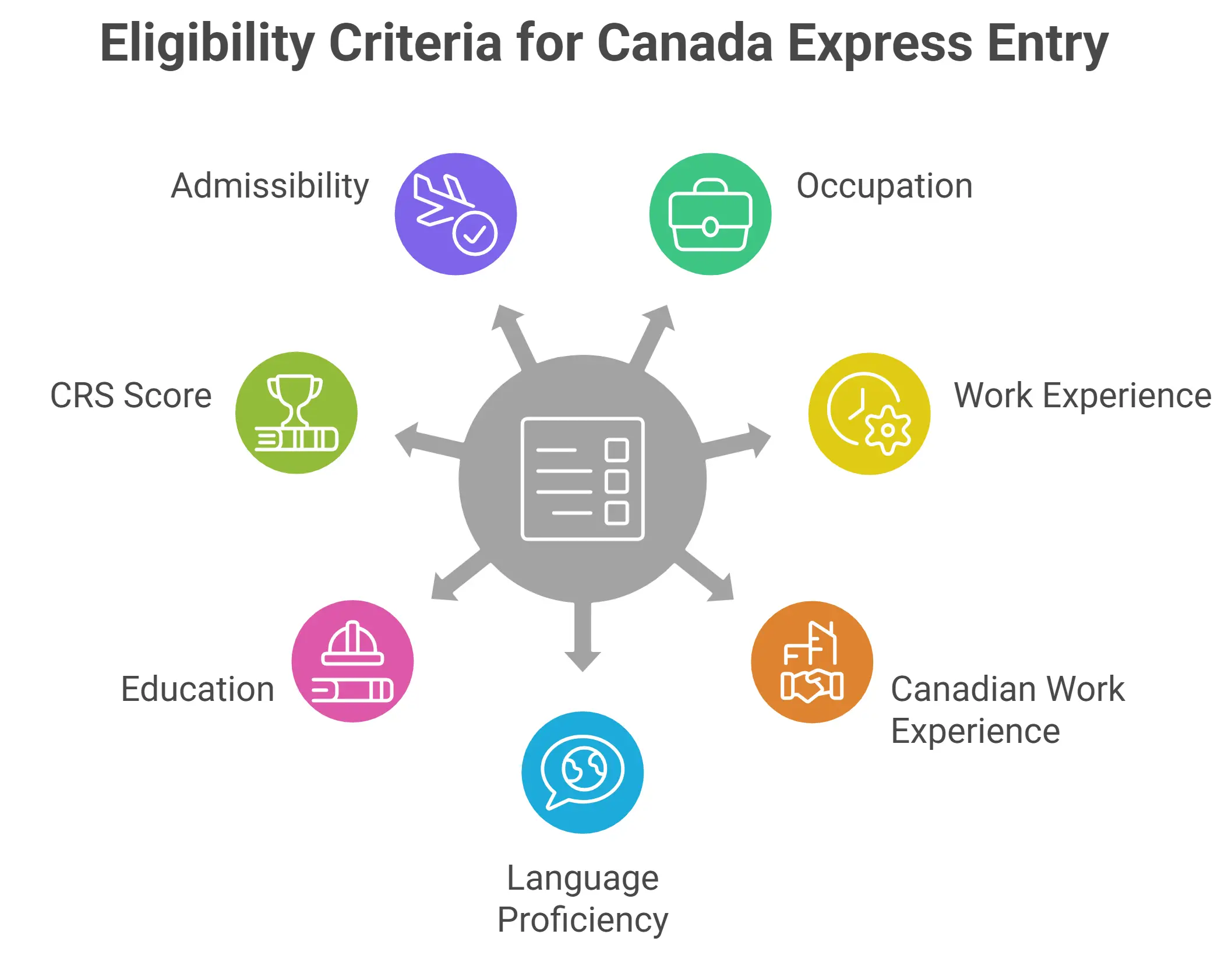
Key eligibility requirements for Canada Express Entry selection process:
- Occupation: Applicants must work in an eligible occupation under the targeted category, such as physicians, nurses, senior managers, researchers, transport occupations, or military personnel.
- Work Experience: Applicants must have at least 12 months of skilled work experience, either full-time or equivalent part-time, gained within the last 3 years.
- Canadian Work Experience: Certain draws give priority to candidates who have prior Canadian work experience.
- Language Proficiency: Applicants must meet minimum CLB 7 in English or French; French-language draws require CLB 7+ in French.
- Education: Applicants must meet the minimum education requirements for the targeted category, such as a bachelor’s degree for researchers or senior managers.
- CRS Score: Applicants need a competitive CRS score; category-based draws may have lower cut-offs for targeted occupations.
- Other Requirements: Applicants must meet general Express Entry eligibility, including age, admissibility, and valid work experience documentation.
Step by Step Application Process for Canada Express Entry
Candidates applying for Canada Express Entry must follow the correct steps to ensure their profile is eligible and competitive. This includes creating an Express Entry profile, selecting the appropriate occupation category, and submitting all required documents. Following these steps carefully improves the chances of receiving an invitation to apply for permanent residence.
Step 1: Create an Express Entry profile on the IRCC portal with accurate personal, education, and work experience details.
Step 2: Select the targeted occupation category that matches your eligible role.
Step 3: Upload supporting documents such as educational credentials, language test results, and proof of work experience.
Step 4: Ensure your CRS score meets or exceeds the expected cut-off for your targeted category-based draw.
Step 5: Receive an Invitation to Apply (ITA) if selected under the category-based draw.
Step 6: Submit a complete permanent residence application within the deadline, including all required documents and fees.
*Want to apply for Express Entry? Let Y-Axis guide you through entire process.
Key Takeaways for Canada Express Entry Applicants in 2026
The latest Express Entry system focuses on category-based draws for in-demand occupations such as healthcare, STEM, trades, transport, and senior management. Applicants must meet eligibility requirements, have the right work experience, and maintain a competitive CRS score to maximize their chances of receiving an invitation for permanent residence.
Some of the key points for Express Entry applicants in 2026:
- Targeted Categories: Healthcare (physicians, nurses, pharmacists), STEM, trades, transport, and senior management roles.
- Eligibility Requirements: Ensure your occupation, work experience, education, and language scores meet category-specific standards.
- CRS Score: Maintain a competitive score to improve chances in occupation-based draws.
- Canadian Work Experience: Candidates with prior Canadian experience are prioritized in certain draws.
- Document Preparation: Include education credentials, language test results, and proof of work experience.
- Draw Patterns: Monitor CRS trends, draw frequency, and occupation-specific invitations to plan your application.
*Want to apply for Express Entry? Get expert guidance from Y-Axis professionals.
FAQs
What are the latest Canada Express Entry updates for 2026?
The latest Canada Express Entry updates for 2026 include category-based draws targeting in-demand occupations such as healthcare, STEM, trades, transport, and senior management. Work experience requirements have been updated, with several draws now requiring a minimum of 12 months. Canadian work experience and French language skills are also prioritized, reflecting labour market needs and helping applicants increase their chances of receiving an invitation to apply for permanent residence.
What new categories have been added in Canada Express Entry?
Canada Express Entry 2026 introduces new occupation-based categories, including researchers, senior managers, transport occupations, military personnel, and healthcare roles. These new categories aim to address labour shortages and target skilled candidates in specific sectors. Applicants under these categories must meet updated eligibility criteria, including relevant work experience, education, and language proficiency, to increase their chances of receiving an invitation to apply for permanent residence.
How has the work experience requirement changed in Canada Express Entry?
The 2026 Canada Express Entry system has updated work experience requirements for category-based draws. Many targeted draws now require a minimum of 12 months of full-time or equivalent part-time skilled work experience, typically gained within the last three years. Candidates with prior Canadian work experience are prioritized, especially in healthcare, STEM, and French-language draws, ensuring applicants meet the updated criteria to be considered for an invitation to apply.
Which occupations are prioritized in the 2026 Express Entry draws?
Priority in 2026 Express Entry draws is given to occupations facing labour shortages, including healthcare professionals (physicians, nurses, pharmacists), STEM specialists, transport workers, skilled trades, and senior-level managers. French-speaking candidates and those with prior Canadian work experience also receive preference. These targeted draws aim to select skilled workers efficiently while addressing the immediate needs of Canada’s labour market.
How does Canadian work experience affect Express Entry eligibility?
Canadian work experience is now a key factor in 2026 Express Entry draws. Candidates with prior work experience in Canada are prioritized, particularly in healthcare, French-language, and category-based draws. Having Canadian experience can significantly improve a candidate’s CRS score and selection chances. Applicants without Canadian work experience may still qualify but must rely on other factors such as education, language proficiency, and relevant occupation experience.
What is the minimum CRS score for category-based Express Entry draws?
CRS cut-off scores vary in category-based Express Entry draws depending on occupation demand and labour market shortages. Generally, category-based draws have lower cut-offs than general draws, allowing targeted skilled workers to receive invitations even with moderate CRS scores. Candidates can improve their CRS by enhancing language scores, gaining Canadian work experience, or securing additional qualifications to remain competitive in occupation-specific draws.
How often are category-based Express Entry draws held in 2026?
Category-based Express Entry draws in 2026 are conducted regularly alongside general draws, with IRCC issuing invitations for targeted occupations based on labour market needs. The frequency of these draws may vary depending on demand for specific roles such as healthcare, STEM, or senior management. Candidates should monitor updates from IRCC to stay informed about upcoming draws and optimize their profile and CRS score accordingly.
Can French language skills improve chances in Express Entry draws?
Yes, French language proficiency can improve selection chances in 2026 Express Entry draws. French-speaking candidates are prioritized in dedicated French-language category draws and may receive additional CRS points for language skills. Candidates with CLB 7 or higher in French benefit in occupation-specific draws, especially when combined with Canadian work experience, education, and relevant skilled work in demand occupations.
How do category-based draws differ from general Express Entry draws?
Category-based Express Entry draws focus on targeted occupations in demand, such as healthcare, STEM, trades, transport, and senior management, while general draws consider all eligible candidates. Category draws often have lower CRS cut-offs and prioritize candidates with Canadian work experience or French language proficiency. This allows IRCC to address labour shortages efficiently and select applicants for permanent residence based on occupation-specific needs.
What documents are required for category-based Express Entry applications?
Applicants for category-based Express Entry must submit a complete set of documents, including proof of work experience, education credentials, language test results (English or French), and identity documents. Healthcare and other specialized categories may require additional professional licenses or certifications. Accurate documentation is essential to meet eligibility criteria, maintain a competitive CRS score, and ensure the application is considered in targeted draws.
Who is eligible for the new healthcare category in Express Entry?
The new healthcare category in Canada Express Entry 2026 targets skilled professionals like physicians, nurses, dentists, pharmacists, physiotherapists, and medical laboratory technologists. Eligible candidates must have at least 12 months of relevant work experience, meet the minimum education requirements, and achieve CLB 7 or higher in English or French. Canadian work experience is prioritized, improving chances of receiving an invitation to apply for permanent residence.
How can STEM professionals apply under the 2026 Express Entry updates?
STEM professionals can apply under the updated Canada Express Entry system by creating an Express Entry profile and selecting the relevant occupation category. Applicants must meet eligibility criteria, including at least 12 months of skilled work experience, recognized education, and language proficiency. Category-based draws targeting STEM roles prioritize candidates with Canadian experience and competitive CRS scores to receive an invitation for permanent residence.
Are senior managers included in the new Express Entry categories?
Yes, senior managers are now part of the new occupation-based categories in Canada Express Entry 2026. Eligible roles include corporate executives, operations managers, financial managers, and senior administrative leaders. Applicants must meet updated work experience requirements, demonstrate relevant education, and achieve the minimum language scores. Category-based draws targeting senior managers prioritize candidates with Canadian work experience to improve selection chances.
What role do military personnel play in Canada Express Entry 2026?
Military personnel are included in the new occupation-based categories for Express Entry 2026, focusing on skilled trades and technical roles aligned with Canadian Armed Forces requirements. Candidates must meet eligibility criteria, including work experience, education, and language proficiency. Category-based draws prioritize applicants with relevant experience to fill labour shortages in military-aligned roles, increasing the likelihood of receiving an invitation to apply for permanent residence.
How does IRCC select candidates for occupation-specific draws?
IRCC selects candidates for category-based Express Entry draws based on occupation demand, labour shortages, CRS scores, Canadian work experience, and language proficiency. Targeted draws focus on specific sectors like healthcare, STEM, trades, transport, and senior management. By prioritizing skilled applicants in high-demand roles, IRCC ensures that selected candidates meet Canada’s labour market needs while improving their chances of receiving an invitation to apply for permanent residence.
Can I update my Express Entry profile after submission for category draws?
Yes, applicants can update their Canada Express Entry profile after submission. Updates can include changes in work experience, education, language test scores, or Canadian employment. Ensuring your profile reflects the most accurate and recent information can improve your CRS score and eligibility for category-based draws. Timely updates are crucial for targeted occupation draws, as IRCC prioritizes candidates who meet updated requirements and have competitive profiles.
How long does it take to receive an ITA in category-based draws?
The time to receive an Invitation to Apply (ITA) in category-based Express Entry draws varies depending on occupation demand, CRS score, and draw frequency. Generally, candidates with high CRS scores, Canadian work experience, or French language skills receive ITAs faster. Monitoring IRCC draw announcements and maintaining an updated, accurate profile ensures applicants maximize their chances of receiving an ITA for permanent residence in a timely manner.
What is the impact of labour shortages on Express Entry selection?
Labour shortages directly influence Canada Express Entry 2026 selection. Category-based draws prioritize occupations facing shortages, such as healthcare, STEM, trades, transport, and senior management. Candidates in these roles may benefit from lower CRS cut-offs and targeted invitations. This approach ensures that Canada fills critical skilled positions efficiently while giving applicants in high-demand occupations a competitive advantage for receiving an invitation to apply for permanent residence.
How do I improve my CRS score for targeted Express Entry draws?
Applicants can improve their CRS score by enhancing language proficiency, gaining Canadian work experience, pursuing higher education, or obtaining a valid job offer. For targeted category-based draws, CRS points are influenced by occupation demand and labour market priorities. Combining education, experience, and language skills increases selection chances, particularly for high-demand categories like healthcare, STEM, and trades, boosting the likelihood of receiving an Invitation to Apply for permanent residence.
Where can I check the latest Canada Express Entry draws and results?
The latest Canada Express Entry draws and results are available on the official IRCC website. IRCC posts draw dates, targeted occupation categories, CRS cut-offs, and the number of invitations issued. Applicants can also subscribe to updates to stay informed about upcoming category-based draws, occupation-specific selections, and changes in eligibility criteria. Regularly checking these updates ensures candidates can plan their applications strategically.
{
"@context": "https://schema.org/",
"@type": "BreadcrumbList",
"itemListElement": [
{
"@type": "ListItem",
"position": 1,
"name": "Home",
"item": "https://www.y-axis.ca/"
},
{
"@type": "ListItem",
"position": 2,
"name": "Blog",
"item": "https://www.y-axis.ca/blog/"
},
{
"@type": "ListItem",
"position": 3,
"name": "Canada Express Entry Updates 2026 New Categories Key Changes",
"item": "https://www.y-axis.ca/blog/canada-express-entry-updates-2026-new-categories-key-changes/"
}
]
},
{
"@context": "https://schema.org",
"@type": "BlogPosting",
"@id": "https://www.y-axis.ca/blog/canada-express-entry-updates-2026-new-categories-key-changes/#blogposting",
"headline": "What's New in Canada Express Entry System? New Categories, Rules & Updates for Applicants",
"description": "Latest Canada Express Entry updates for 2026 include new categories, rule changes, and eligibility shifts. Find out the key changes and recent draw trends affecting the application process for permanent residence.",
"image": {
"@type": "ImageObject",
"url": "https://www.y-axis.ca/assets/cms/2026-04/Category-Based-Express-Entry.jpg"
},
"url": "https://www.y-axis.ca/blog/canada-express-entry-updates-2026-new-categories-key-changes/",
"mainEntityOfPage": {
"@type": "WebPage",
"@id": "https://www.y-axis.ca/blog/canada-express-entry-updates-2026-new-categories-key-changes/"
},
"speakable": {
"@type": "SpeakableSpecification",
"cssSelector": [
"h1",
".article-intro",
".sector-intro",
".skills-summary"
]
},
"keywords": "Canada Express Entry 2026, Express Entry new categories, Canada PR updates, Express Entry rule changes, Canada immigration updates",
"about": [
{
"@type": "Thing",
"name": "Canada Express Entry 2026 Updates"
},
{
"@type": "Thing",
"name": "New Express Entry Categories"
},
{
"@type": "Thing",
"name": "Canada PR Rule Changes"
}
]
},
{
"@context": "https://schema.org",
"@type": "FAQPage",
"mainEntity": [
{
"@type": "Question",
"name": "What are the latest Canada Express Entry updates for 2026?",
"acceptedAnswer": {
"@type": "Answer",
"text": "The latest Canada Express Entry updates for 2026 include category-based draws targeting in-demand occupations such as healthcare, STEM, trades, transport, and senior management. Work experience requirements have been updated, with several draws now requiring a minimum of 12 months. Canadian work experience and French language skills are also prioritized, reflecting labour market needs and helping applicants increase their chances of receiving an invitation to apply for permanent residence."
}
},
{
"@type": "Question",
"name": "What new categories have been added in Canada Express Entry?",
"acceptedAnswer": {
"@type": "Answer",
"text": "Canada Express Entry 2026 introduces new occupation-based categories, including researchers, senior managers, transport occupations, military personnel, and healthcare roles. These new categories aim to address labour shortages and target skilled candidates in specific sectors. Applicants under these categories must meet updated eligibility criteria, including relevant work experience, education, and language proficiency, to increase their chances of receiving an invitation to apply for permanent residence."
}
},
{
"@type": "Question",
"name": "How has the work experience requirement changed in Canada Express Entry?",
"acceptedAnswer": {
"@type": "Answer",
"text": "The 2026 Canada Express Entry system has updated work experience requirements for category-based draws. Many targeted draws now require a minimum of 12 months of full-time or equivalent part-time skilled work experience, typically gained within the last three years. Candidates with prior Canadian work experience are prioritized, especially in healthcare, STEM, and French-language draws, ensuring applicants meet the updated criteria to be considered for an invitation to apply."
}
},
{
"@type": "Question",
"name": "Which occupations are prioritized in the 2026 Express Entry draws?",
"acceptedAnswer": {
"@type": "Answer",
"text": "Priority in 2026 Express Entry draws is given to occupations facing labour shortages, including healthcare professionals (physicians, nurses, pharmacists), STEM specialists, transport workers, skilled trades, and senior-level managers. French-speaking candidates and those with prior Canadian work experience also receive preference. These targeted draws aim to select skilled workers efficiently while addressing the immediate needs of Canada’s labour market."
}
},
{
"@type": "Question",
"name": "How does Canadian work experience affect Express Entry eligibility?",
"acceptedAnswer": {
"@type": "Answer",
"text": "Canadian work experience is now a key factor in 2026 Express Entry draws. Candidates with prior work experience in Canada are prioritized, particularly in healthcare, French-language, and category-based draws. Having Canadian experience can significantly improve a candidate’s CRS score and selection chances. Applicants without Canadian work experience may still qualify but must rely on other factors such as education, language proficiency, and relevant occupation experience."
}
},
{
"@type": "Question",
"name": "What is the minimum CRS score for category-based Express Entry draws?",
"acceptedAnswer": {
"@type": "Answer",
"text": "CRS cut-off scores vary in category-based Express Entry draws depending on occupation demand and labour market shortages. Generally, category-based draws have lower cut-offs than general draws, allowing targeted skilled workers to receive invitations even with moderate CRS scores. Candidates can improve their CRS by enhancing language scores, gaining Canadian work experience, or securing additional qualifications to remain competitive in occupation-specific draws."
}
},
{
"@type": "Question",
"name": "How often are category-based Express Entry draws held in 2026?",
"acceptedAnswer": {
"@type": "Answer",
"text": "Category-based Express Entry draws in 2026 are conducted regularly alongside general draws, with IRCC issuing invitations for targeted occupations based on labour market needs. The frequency of these draws may vary depending on demand for specific roles such as healthcare, STEM, or senior management. Candidates should monitor updates from IRCC to stay informed about upcoming draws and optimize their profile and CRS score accordingly."
}
},
{
"@type": "Question",
"name": "Can French language skills improve chances in Express Entry draws?",
"acceptedAnswer": {
"@type": "Answer",
"text": "Yes, French language proficiency can improve selection chances in 2026 Express Entry draws. French-speaking candidates are prioritized in dedicated French-language category draws and may receive additional CRS points for language skills. Candidates with CLB 7 or higher in French benefit in occupation-specific draws, especially when combined with Canadian work experience, education, and relevant skilled work in demand occupations."
}
},
{
"@type": "Question",
"name": "How do category-based draws differ from general Express Entry draws?",
"acceptedAnswer": {
"@type": "Answer",
"text": "Category-based Express Entry draws focus on targeted occupations in demand, such as healthcare, STEM, trades, transport, and senior management, while general draws consider all eligible candidates. Category draws often have lower CRS cut-offs and prioritize candidates with Canadian work experience or French language proficiency. This allows IRCC to address labour shortages efficiently and select applicants for permanent residence based on occupation-specific needs."
}
},
{
"@type": "Question",
"name": "What documents are required for category-based Express Entry applications?",
"acceptedAnswer": {
"@type": "Answer",
"text": "Applicants for category-based Express Entry must submit a complete set of documents, including proof of work experience, education credentials, language test results (English or French), and identity documents. Healthcare and other specialized categories may require additional professional licenses or certifications. Accurate documentation is essential to meet eligibility criteria, maintain a competitive CRS score, and ensure the application is considered in targeted draws."
}
}
]
}
]